


Thermal Scope for Air Rifles: UK Guide
Using a thermal scope on an air rifle is becoming increasingly popular in the UK, particularly for ratting and short-range pest control. But choosing the right thermal scope for air rifles is very different from choosing a thermal scope for a standard rifle.
Air rifles operate at much shorter distances, are lighter in weight, and are typically used around buildings, barns and enclosed land. That means many high-powered thermal scopes are unnecessary, and in some cases, not very helpful at all.
This guide explains what you need to consider when choosing a thermal scope for air rifle use, what specifications you can safely ignore, and which type of thermal scope makes the most sense for UK air rifle shooting.
Our Recommended Thermal Scope for Air Rifles
When it comes to air rifles, the “best” thermal scope isn’t the most powerful or expensive option. It’s the scope that works properly at realistic air rifle distances, stays well balanced on lighter rifles, and delivers clear target identification without unnecessary complexity.
Based on our testing and customer feedback, our recommended thermal scope for air rifles is the:
Nocpix BOLT P25R (256×192)
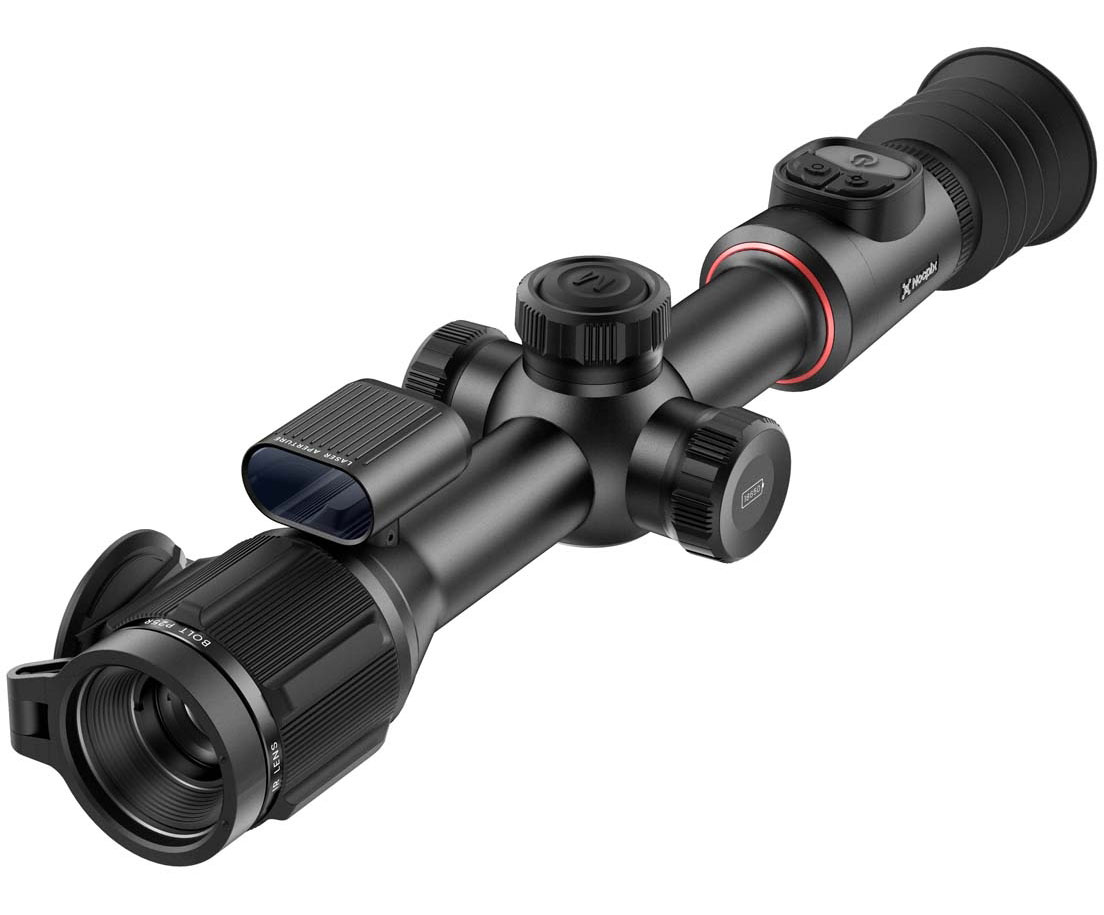
The Nocpix BOLT P25R is a sensible, well-balanced choice for air rifle shooters, particularly if you are going ratting or any other kind of short-range pest control.
It offers enough thermal clarity to identify small quarry at typical air rifle distances, without the cost, weight or over-specification that often comes with higher-end rifle-focused thermal scopes.
Why the Nocpix BOLT P25R suits air rifles:
- A 256×192 thermal sensor, which is well suited to typical air rifle ranges
- A 25mm focal length, providing a wide field of view for close-range work
- A compact, lightweight design that maintains good rifle balance
- 12µm pixel pitch, helping deliver sharper detail at short distances
- A built-in laser rangefinder, useful as a reference for consistent air rifle ranges
- Clean image processing that separates heat sources clearly without excessive noise
Crucially, it avoids the common mistake of over-specification. Higher-resolution thermal scopes are often designed for firearms and offer little real-world benefit on sub-12ft/lb air rifles, while adding unnecessary cost and bulk.
Are Thermal Scopes Legal on Air Rifles in the UK?
Thermal scopes are legal to use on air rifles in the UK, provided they are used responsibly and in line with existing shooting laws.
There are no specific restrictions on thermal optics themselves. As with all air rifle shooting, you must have permission to shoot on the land, remain within legal power limits, and only target appropriate quarry species.
Why Air Rifle Distances Change What Specs Matter
Most air rifle shooting takes place at relatively short distances, typically between 10 and 40 metres, occasionally stretching further in ideal conditions.
At these ranges, close-range image clarity matters far more than long-distance detection. High base magnification, narrow fields of view and very high sensor resolutions can actually make close-range shooting harder, particularly when targeting small, fast-moving quarry such as rats.
Thermal Sensor Resolution for Air Rifle Use
Choosing the right resolution is about what actually works at air rifle distances, not chasing the biggest numbers.
A 256×192 sensor is often more than capable for typical air rifle pest control, providing clear heat detection and sufficient detail for identification at close range. It also keeps costs and weight down.
A 384×288 sensor offers a noticeable improvement in clarity and can be useful for those shooting more regularly outdoors or across slightly longer distances. However, moving beyond this level rarely delivers meaningful benefits for air rifle use.
Pixel Pitch and Why It Matters More Than Big Numbers
Pixel pitch is easy to overlook, but it has a big impact on how clear a thermal image looks at close range.
Put simply, it describes how closely packed the thermal pixels are on the sensor. A smaller pixel pitch means more detail in the image, which makes it easier to identify small targets when shooting at typical air rifle distances.
A 12µm pixel pitch allows more pixels to be packed into the same sensor size, improving clarity and definition. This is particularly helpful when identifying small quarry and when using digital zoom at short ranges — a common scenario for air rifle shooters.
NETD Sensitivity at Close Range
NETD measures how well a thermal scope detects small differences in temperature.
For air rifle shooting, extremely low NETD figures aren’t essential. Most shots take place at close range where heat contrast is already clear. Values below 35mK perform well in the vast majority of air rifle scenarios, with lower figures offering diminishing returns.
In practice, stable image processing and sensible magnification matter far more than chasing the lowest NETD numbers.
Focal Length and Field of View for Air Rifles
Air rifle shooters generally benefit from a wider field of view, rather than high magnification.
Shorter focal lengths, usually 19–25mm, make it easier to locate and track quarry at close range, especially in confined spaces or around buildings. Longer focal lengths narrow the image and can make close-range shooting feel restrictive and awkward.
Weight, Balance and Rifle Handling
Air rifles are lighter and more sensitive to added weight than firearms. A heavy thermal scope can quickly upset balance, making the rifle uncomfortable to handle and harder to control for precise shots.
Compact thermal scopes preserve natural handling and reduce fatigue, which is particularly important for off-hand shooting and longer pest control sessions.
Do Air Rifles Need a Laser Rangefinder?
In most cases, no.
Air rifle ranges are short and usually well understood by the shooter. While a laser rangefinder can be useful as a reference, it’s not essential and often adds cost and weight without dramatically improving effectiveness.
Image Processing and Ease of Use
At air rifle distances, good image processing often matters more than raw specifications. Clean contrast, smooth refresh rates and low noise make it easier to identify small targets quickly.
Simple, intuitive controls are also important, particularly when shooting in low light, where complex menus can become frustrating.
When Thermal Scopes Make Sense on Air Rifles
Thermal scopes are particularly effective for night-time pest control, especially ratting around buildings, barns and permission land. They allow shooters to locate quarry without visible light, reducing disturbance and improving awareness.
They are less suitable for daytime target shooting or casual plinking, where traditional optics or night vision are often more appropriate.
Frequently Asked Questions – Thermal Scopes for Air Rifles
Can you legally use a thermal scope on an air rifle in the UK?
Yes, provided you are shooting legally, within power limits and with landowner permission.
What thermal resolution is best for air rifles?
For most shooters, 256×192 or 384×288 offers the best balance of performance and value.
Is higher resolution always better?
No. At air rifle distances, higher resolution often increases cost without improving real-world performance.
Are thermal scopes too heavy for air rifles?
Some can be. Always check weight and balance before choosing a scope.
Can thermal scopes be used during the day?
Yes, although image contrast can reduce in warmer conditions.
The Final Word on Thermal Scopes for Air Rifles
Thermal scopes can be extremely effective on air rifles when chosen with realistic expectations. The key is avoiding over-specification and focusing on what genuinely improves performance at air rifle distances.
For most UK shooters, a compact thermal scope with a sensible resolution, short focal length and good image processing will deliver far better results than an expensive unit designed for long-range firearms.
