


Thermal Scope vs Night Vision Scope
When choosing between a thermal vs night vision scope, it's important to think about how they both work and which situations suit each one.
Both are designed to help you see in the dark, but they work in completely different ways.
This guide looks at how thermal and night vision scopes work, what each shows you and where they are most useful.
Thermal Scope vs Night Vision Scope
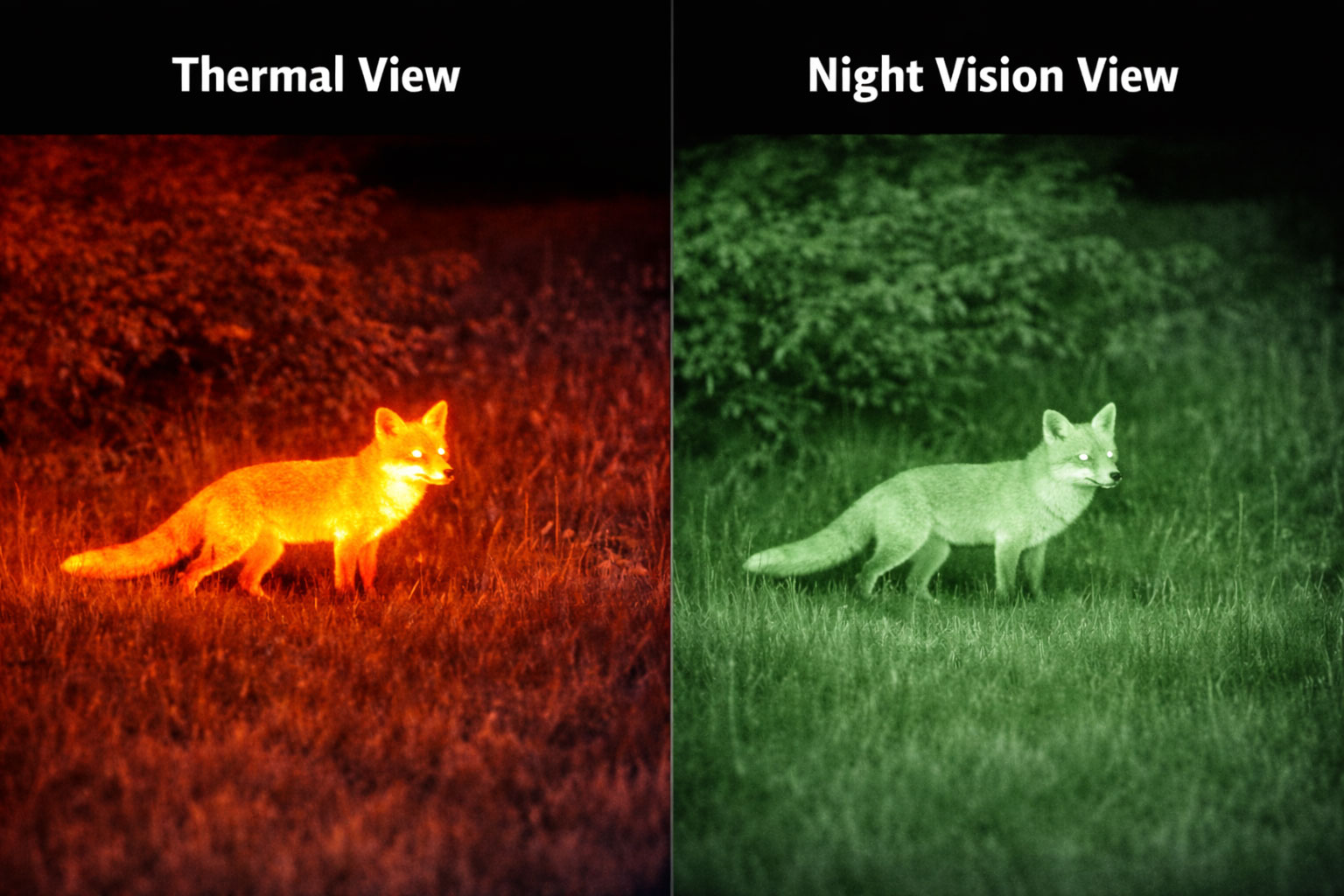
This is an example comparison of thermal and night vision style views. Thermal imaging highlights heat signatures, making the fox stand out clearly against a cooler background. Night vision brightens the entire scene using available light, revealing more natural detail but typically with less contrast between the animal and its surroundings.
What Is the Core Difference Between Thermal and Night Vision?
The main difference is that thermal scopes detect heat while night vision scopes amplify light.
A thermal scope senses tiny differences in temperature between objects and converts those differences into a visible digital image. It does not rely on moonlight, starlight, or infrared illumination.
Night vision gathers small amounts of available light and intensifies it so the human eye can see a brighter version of the scene.
In plain English, thermal shows warmth, while night vision shows light reflected from real surfaces.
What Does Thermal Imaging Show Compared with Night Vision?
Thermal and night vision produce very different visual experiences.
A thermal scope displays simplified shapes based on temperature contrast. Animals, people, and machinery usually stand out clearly against cooler surroundings, even if hidden by darkness or partial cover. Fine visual detail, however, is limited because the image is built from heat rather than colour or texture.
Night vision shows a more natural scene. Trees, fences, ground texture, and movement appear recognisable because the device is still working with reflected light. The image is typically green or monochrome, but it preserves detail that thermal cannot provide.
Quick Comparison
- Thermal: Reveals presence and heat
- Night Vision: Reveals shape and surface detail
Both are clear in different ways, but are designed for different purposes.
Which Works Better in Complete Darkness?
Thermal scopes function equally well in full darkness because they do not depend on any light source. As long as a temperature difference exists, the image can form.
Night vision performance depends on available light. On a clear, moonlit night it may appear surprisingly detailed. In deep woodland or heavy cloud cover, the image can become darker unless supported by an infrared illuminator.
This makes thermal generally more consistent across changing light conditions, while night vision performance varies with the environment.
Can Thermal and Night Vision See Through Obstacles?
No, neither technology can see through solid objects such as walls, thick tree trunks, or earth. This is a common misconception.
Thermal can sometimes detect heat through light vegetation, mist, or shadow, which may give the impression of seeing through cover. In reality, it is simply sensing heat where light-based vision struggles.
Night vision cannot do this because it still relies on reflected light reaching the lens. Dense foliage or complete darkness will block the image.
Is One Better for Identifying Animals?
Identification depends on what information you need.
Thermal is excellent for detecting that something is present. Warm-blooded animals usually stand out immediately, even at a distance or in tall grass.
Night vision is often better for confirming exactly what the animal is, because it preserves outline detail and environmental context.
How Do Weather and Temperature Affect Each Technology?
Environmental conditions influence both systems, but in different ways.
Thermal performance depends heavily on temperature contrast. Cooler evenings or cold mornings usually produce clearer separation between animals and background. Warm summer ground or strong sunlight can slightly reduce contrast.
Night vision depends more on light levels and clarity of air. Fog, heavy rain, or thick cloud can reduce visible detail by scattering light before it reaches the device.
In everyday British weather, this means each technology has moments where it feels naturally stronger.
When Is Thermal More Useful in the UK?
Thermal tends to be most valuable where detection is the priority rather than visual detail.
Typical real-world uses include wildlife monitoring, pest control planning, land management awareness, and search or safety observation in darkness.
It is particularly helpful in environments with:
- Dense grass or hedgerows
- Uneven ground with shadowed areas
- Minimal ambient light
- Animals that remain still and hidden
These are situations where heat contrast reveals what normal vision cannot.
The Best Thermal Scopes in the UK
When Does Night Vision Make More Sense?
Night vision becomes more useful when context and detail matter.
Seeing terrain features, boundaries, and precise animal outline can be important for navigation, observation, or confirmation of what is being viewed.
It often feels more intuitive for beginners because the scene resembles natural sight rather than an abstract heat image.
For most UK users, the comparison is not about declaring a single winner. Instead, it is about matching the strength of each technology to the situation at hand.
- Thermal: Unmatched ability to reveal hidden heat signatures
- Night Vision: Clearer visual context and recognisable detail
Seeing the two as complementary rather than competing usually provides the clearest understanding of their roles.
Thermal vs Night Vision Scope FAQs
Do thermal scopes work in daylight?
Yes. Thermal detects heat rather than light, so it functions during both day and night.
Is night vision clearer than thermal?
Night vision usually shows more natural detail, while thermal shows stronger heat contrast.
Can thermal replace night vision completely?
Not entirely. Each technology serves different observational purposes.
Which works better in fog?
Light fog may affect both, but heavy moisture typically reduces night vision detail more noticeably.
Are both legal to own in the UK?
Yes. Ownership is legal, though lawful field use always depends on context and permissions.
Do animals notice thermal or night vision devices?
Neither emits visible light detectable to animals under normal use.
Which is easier for beginners to understand?
Night vision often feels more familiar because the image resembles natural sight.
Do both require batteries?
Yes. Both are electronic devices powered by rechargeable or replaceable batteries.
